|
IIJNM
offers the following three programs:
A Postgraduate
Diploma for students with a Bachelors degree.
A Diploma
program for students who have completed pre-university or Standard
12.
In addition,
selected number of i-Learning
courses will be offered soon in association with
BBC for distance
(correspondence) learners. These courses require using modules
offered through the Internet. For
further description, please see below at the bottom of this page.
Both the diploma
programs consist of core courses
including advanced seminars, electives,
media workshops and a master's
thesis project. Depending on the type of diploma program, the
requirements vary. These courses are offered in two semesters: July-December
and January-June.
IIJNM offers
concentrations in Television
journalism, Radio journalism,
Newspaper journalism, Magazine
journalism and New Media (Web)
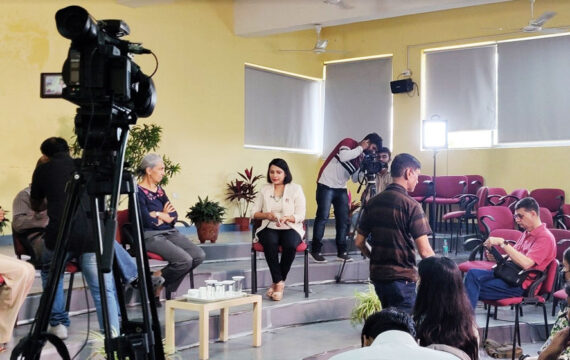
journalism. Television and Radio students produce both television
and radio programs as part of their Broadcast curriculum, with special
focus on their area of interest TV or radio. Print and New
Media students are required to cover both areas, with special focus
on newspaper, magazine or web journalism, respectively.
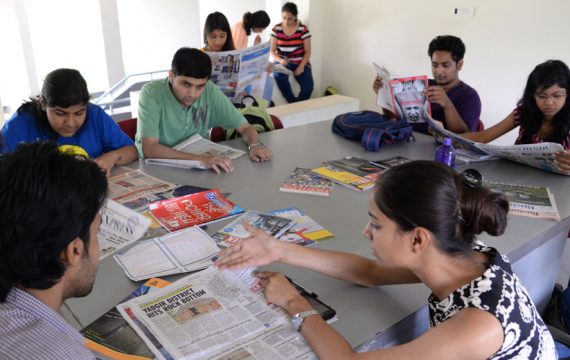
Students concentrating in newspaper journalism must
take the workshop that requires producing an in-house newspaper.
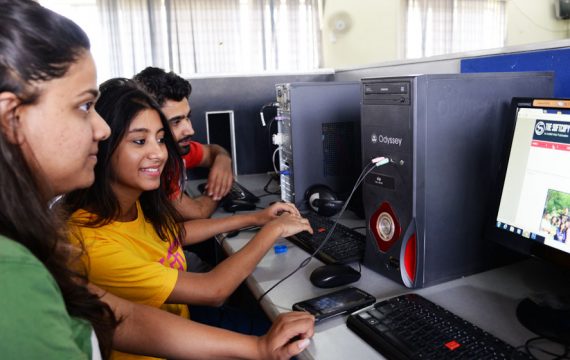
Magazine journalism students produce a monthly magazine. New Media
students produce a weekly on-line publication. Broadcast students
may produce both TV and radio news segments and documentaries, depending
on their particular area(s) of interest.
Core
courses introduce students to reporting and writing, and provide
a foundation from which much of the subsequent program work is done.
The emphasis is on developing their reporting and writing skills.
Students also learn the techniques and tools available to them,
and understand the ethical and legal issues involved in professional
journalism.
Advanced
area seminars emphasize selected major areas of journalism,
namely, national political reporting, international news coverage,
business and financial reporting, and developmental journalism.
Advanced concentration seminars
provide further skills in the chosen concentration Television,
Radio, Newspaper, Magazine or New Media.
Elective
courses allow students to specialize in one or more subject
areas such as political reporting, international news coverage,
investigative reporting, business reporting, digital photo journalism
and others.
Media
workshops are in Television, Radio, Newspaper, Magazine and
New Media. Each student is required to pick one specialty. In the
Television workshop students plan and produce television programs
including news bulletins and documentaries on various topics. Similarly
in the Radio workshop students work with sound and learn to produce
different kinds of radio programs. In the Newspaper workshop, students
plan and write a newspaper several times during the semester on
politics, crime, health, society and other topics. Magazine workshop
requires publishing a monthly magazine. Students learn how to interview,
write and edit. New Media workshop builds on the course on New Media
tools, and students learn to apply these techniques to traditional
story-telling elements. New Media workshop requires publishing both
a newspaper and an on-line magazine several times during the semester.
In its scope
and duration, the master's thesis project
is the postgraduate student's major effort of the year, an in-depth
exploration of a topic as a journalist would pursue it. The master's
thesis project may be executed in Television, Radio, Print or New
Media. Each student is assigned an adviser who helps select a topic
and provides guidance in focusing the project, conducting the research,
and reporting, organizing and writing. The master's thesis project
is intended to demonstrate students' ability to conduct and sustain
research over several months, their ability to gather and organize
large amounts of material, and their capacity to present that material
clearly and accurately.
Further
note on i-Learning Program:
The i-Learning
project is aimed at facilitating professional development in the
Indian media by offering online learning courses and interactive
forums. It is designed for working journalists and media managers
for improving their skills at their pace. Training will cover courses
offered through the diploma programs, with in-class practical training
through on-site workshops.
The Indian
Institute for Journalism & New Media (IIJNM) is one of two institutions
in India selected by the British Broadcasting Corporation (other
being the Indian Institute for Mass Communications) for i-Learning.
By the end of the project, these partners will have gained both
the skills and the tools (including local ownership of the BBC’s
online learning system, iLearn) to run blending learning programmes
of their own.
The Indian
Institute for Journalism & New Media will offer the iLearn
blended learning experience to newspaper
and Internet journalists. IIJNM trainers will work in
close partnership with specialists from the Danish School of Journalism.
The centre will also be given exclusive rights to use iLearn courses
in newspaper and web journalism at the end of the project. Facilities
and training will be provided to enable IIJNM to continue developing
online courses beyond the project lifecycle. IIJNM will also develop
links with other international institutions which have been designated
official iLearn partners. These are located both in transitional
countries and in the UK, Holland, Mexico and Sweden.
For further
information on courses to be offered under i-Learning, please contact
IIJNM at admin@iijnm.org
|